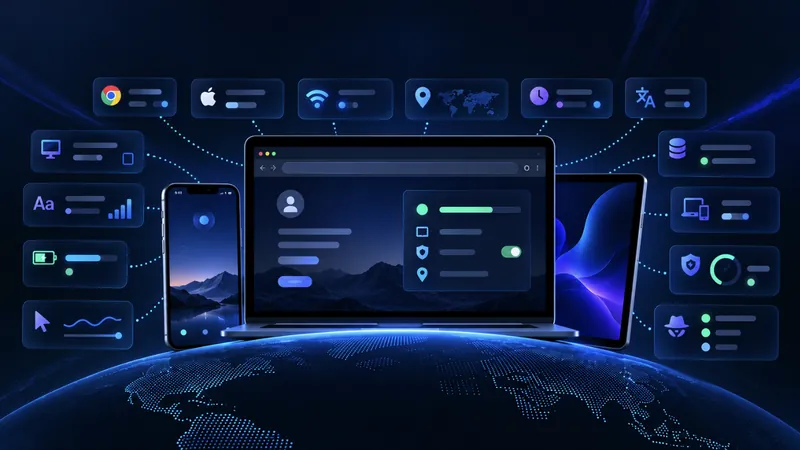
Device intelligence
Different accounts. Same operation. Surface coordinated device farms, emulators, and suspicious device reuse, and connect sessions that look unrelated at first glance.
Explore device intelligenceFingerly is a device fingerprinting API for web and mobile. See the device, understand the intent, and catch bots, VPNs and device farms before they become your problem. Privacy by design.
Every identification answers two questions: which device is this, and what is it doing? One session, one visitor, one score, and every check behind it.
Nothing is read until you ask. Identify this browser to open its session.
There is no visitor ID, suspect score or signal report to show yet. Identify this browser to create one real response and open the inspector.
A signal is a clue, not a verdict. Your application stays in control of the decision. A few checks need history this demo keeps none of, and it marks those rather than answering them.
From an anonymous visit to a coordinated device farm. Bring device fingerprinting, VPN and proxy detection and bot detection into one view.
Different accounts. Same operation. Surface coordinated device farms, emulators, and suspicious device reuse, and connect sessions that look unrelated at first glance.
Explore device intelligenceLook beyond the IP. Reveal VPNs, proxies, Tor exit nodes, and hosting networks. Context about the connection, not assumptions about the person.
Explore network signalsSpot the script. Identify automation, headless environments, and scripted activity. Separate suspicious bots from the people you want to welcome.
Understand bot signalsPrivate. Not invisible. Surface supported private-browsing indicators alongside device and session context. Privacy mode alone is never a fraud verdict.
Explore private browsingQuestion the disguise. Highlight inconsistent browser attributes, emulated environments, and signs of tampering. Know when a session does not add up.
Inspect environment signalsSignal availability and confidence depend on the browser, device, and integration.
Add intelligence at the moments that matter. Keep your product experience, and your decision-making, your own.
Collect a session event at a meaningful touchpoint such as signup, login or checkout. Forward its request ID to your server for trusted verification.
Bring device, network, and automation signals together into a suspect score. Understand the indicators behind each result.
Let trusted sessions through. Step up verification when needed. Investigate suspicious activity with evidence.
Device intelligence is not a single-use feature. Put the same signals to work across your customer journey, from multi-accounting and promo abuse to account takeover and payment fraud.
Account takeover prevention: recognize familiar devices and flag unusual sessions at login, including the automation behind credential stuffing. Bring context to account-takeover reviews without treating every visitor as a threat.
Example workflows. Detection signals inform, not replace, your risk policies.
A device fingerprinting API with a clear integration path from your frontend to your backend, SDKs for the web, iOS and Android, and signed webhooks. Structured results you can understand, inspect, and put to work in your own application.
Readable SDK and API patterns.
Server-side verificationKeep secret keys on your backend.
Structured responsesSignals with explicit context.
Your existing workflowSigned webhooks into your risk logic.
Web, mobile and serverOne integration path on every platform.
Free test environmentsDevelopment and staging keys cost nothing.
Explainable resultsEvery score lists the signals behind it.
Data residencyOne API, one database, in the EU.
Every SDK is released and ready to install. See the SDK docs for setup.
Device fingerprinting SDKs for the web, iOS and Android apps, and your server.
Your signup flow is different from your checkout. Choose the signals that matter, set the conditions for your fraud rules, and decide how your application should respond.
Inspect the sessionContext beats blanket blocking. A customer on a VPN is not the same as a bot running a device farm. Your policies should know the difference.
Interactive policy sandbox. No real sessions are blocked or altered.
Cookieless device fingerprinting still belongs inside a responsible data strategy. Define what you collect, who can access it, and how long you keep it, before the first production request.
Collect the context your use case actually needs.
Set a retention policy that fits your obligations.
Keep server secrets private and permissions scoped.
Make your data practices understandable.
Implementation principles, not certification claims. Production controls and jurisdiction-specific requirements must be reviewed before launch.
Pay as you go device intelligence, prepaid. No plans, no seats, no monthly fee: add funds once, and each request spends from the balance, with volume discounts built in.
A visitor ID, the suspect score and every signal, in one response. Usage-based, per-request pricing: no detection is held back for a higher plan, and the price drops as the month grows.
When a browser gives too little away to identify, the request is free, and you still get the network picture.
Development and staging keys, retries of the same request, lookups that fail, and reading results from your server.
Every new account starts with it, and no card is needed to spend it. Add funds from $5 when you are ready.
Usually a small share. These are free.
≈ $8.17 a day$0.00245 per request
| Identifications | 98,000 × $0.0025 | $245.00 |
|---|---|---|
| Not identified, development, staging & retries | free | $0.00 |
| Month | $245.00 |
No card needed. 400 identifications before you add funds.
Prices in USD, excluding taxes. Only production traffic is charged, at the price in effect when each request is made. The calculator is an estimate, not a quotation.
Introductory guides on device fingerprinting, fraud signals and risk policy, each on a page of its own.
Device fingerprinting, fraud detection and pay as you go pricing, answered. Start here.
See every question Talk through your use caseDevice fingerprinting recognises a returning browser or device from what it reports about itself, instead of from a cookie it stores. A cookie lives in the browser, so clearing it or opening a private window starts over. Fingerly’s browser SDK writes no cookies and nothing to local storage, and the visitor ID is issued and remembered on Fingerly’s side.
Yes. Native iOS and Android SDKs, with React Native, Flutter and Lynx bridges, send the same identify request as the web SDK and get the same response. In an app the device is recognised by a random ID the SDK keeps, never by its hardware, and the native SDKs add checks for emulators, rooted and jailbroken devices.
Yes. Every identification classifies the address as a commercial VPN, a datacenter or residential proxy, a Tor exit node or a hosting network, and flags a mismatch with the device’s own region. Each one is a signal with a weight you set, because a VPN alone is context, not a verdict.
An identification is a request to evaluate a browser or device session and return its identifier and available signals. It is a usage event, not a monthly active user or a dashboard seat. Repeated identification calls count separately. Define which moments need a check, such as signup, login, or checkout, rather than identifying on every page render.
No. Every new account starts with $1 of credit, enough for 400 identifications, and no card is needed to spend it. Add funds from $5 when you are ready. Development and staging keys are never charged, so building and testing costs nothing.
No. Privacy tools have legitimate uses. Treat these signals as context alongside account behavior, device history, and transaction risk. A single signal should not automatically result in a blocked customer. In the demo, the VPN check says so: on its own, a tunnelled connection is context, not a verdict.
Yes. The session inspector opens empty, and its identify button runs a real identification of the browser you are reading this in: the same SDK, the same checks, the same score. Nothing is collected until you press it, nothing about the answer is stored on our side, and the visitor ID it shows is genuinely yours, which is why pressing it twice says returning visitor. Your address is placed and checked for a VPN, proxy or Tor the same way a customer’s visitor would be, in our own IP database, and the inspector shows the network and a map of where it was placed. The map tiles come from an open map service. A few checks need to know what a device has done across many requests, and the demo keeps no such history, so it marks those as not answered rather than showing you a clear result nobody computed.
Identify with the client SDK at a moment that matters, send the request ID to your backend, and read the stored result there with a secret key before you decide. The quickstart walks through it in six steps.
Set your collection scope, retention period, access policies, and visitor notices before going live. Requirements depend on your use case and jurisdiction. The privacy section describes design considerations, not a legal assessment or a certification. Have your privacy and legal teams review the production implementation.
Only the total. An identification starts at $0.0025 and falls as the month grows: $0.002 past 250,000 and $0.0015 past a million, with each band pricing the requests inside it. There is no plan to move up to and nothing to negotiate, and the discount applies itself. Billing is prepaid: turn on auto top-up and the balance refills before it runs out. Requests that cannot be identified are free, and retries of the same request are not charged twice.
Fingerly is a device fingerprinting and fraud detection API, also called device intelligence. It gives each visit a visitor ID for the device behind it, detects bots, VPNs, proxies, Tor, device farms, emulators and tampering, and adds the findings into a suspect score under weights you control. Your application decides what to do with it.
Yes. Fingerly is a device fingerprinting API with SDKs for the web, iOS, Android and your server. One identify call returns a visitor ID, the signals that fired and a suspect score, and your backend reads the stored result with a secret key before it decides.
Device intelligence is the context around a session: which device it is, what network it comes from and whether it shows signs of automation or tampering. Fingerly returns that context as a visitor ID, signals and a suspect score, so a signup, login or payment is judged on more than an email address or an IP.
Yes. Fingerly is pay as you go: a prepaid balance, no plans and no monthly fee, from $0.0025 per identification with volume discounts. Requests that cannot be identified are free, and the pricing page has a calculator for your own month.
Yes. Development and staging keys are always free and run the same detection as production, and every new account starts with $1 of free credit, enough for 400 production identifications, with no card needed.
Identify at signup, store the visitor ID beside every new account and read the result on your server. One device creating many accounts shows up as one visitor ID on all of them, and device farm, emulator and private-browsing signals make the cluster more telling. Review clusters, because a shared household is not fraud by itself.
Yes, as evidence for your own review. Check the session when a coupon, bonus or referral reward is claimed and connect the claims to the visitor IDs behind them. Repeat claims from one device, or from a device farm, stand out. Your policy decides whether to allow, review or refuse.
Yes. Fingerly reports driven and headless browsers, declared scrapers, virtual machines and unusually high activity without asking the visitor for anything, so no CAPTCHA or puzzle is needed. Your application decides how to respond, and it can still add a challenge for the sessions that need one.
Fingerly gives you the evidence at login. Identify at login, read the result on your server, recognise the devices an account normally uses, and add a second factor when a login is new and also automated or arriving from Tor. Bot detection flags the automated browsers behind credential stuffing.
It depends on how you use it, and Fingerly claims no certification and gives no legal assurance. Privacy law can treat device identifiers as personal data, so settle your lawful basis and visitor notice first. The SDKs collect nothing until you tell them consent is granted. Have your legal team review your implementation.
Start with the signals, keep your own decisions, and pay as you go, only for what you identify. No credit card needed.